Recommended Vets in Sicily

Recommended Vets in Sicily

This page provides a downloadable list of veterinarians in Sicily that Sigonella Animal Welfare Society Inc. (SAWS) knows and trusts based on experience working with rescued, fostered, and adopted animals.

Because this information is often needed quickly - sometimes in stressful or emergency situations - we also provide it as a printable PDF that can be saved to your phone, shared, or kept on hand.

About this list

Clinics marked “SAWS recommended” are veterinarians we have worked with directly and trust based on experience.
• This list is not exhaustive - Sicily has many veterinary professionals, and availability may vary by location and specialty.
• Pet owners are responsible for choosing the veterinarian that best fits their needs.

If you have a positive experience with a veterinarian not listed here, you are welcome to let us know so we can consider expanding this resource.

Important reminder

Always bring your codice fiscale to veterinary appointments. Italian fiscal law requires it at the time of payment.

Pass it around 🥰 Sharing is caring 🐶

Download the list in PDF here


24 Hour Veterinary HOSPITALS
Clinics offering emergency and overnight care
Phone, email & website
Hours of Operation
Centro Veterinario Ferrarotto
Via Rametta 49b/c
Catania

SAWS Recommended

095-731-2102
095-731-5889
Website
Send email
Appointments:
Open Mon-Sun, 24 hours a day.
Walk in emergencies
Overnight care & surgical procedures
For appt. with Dr. Amaduri (English speaking): send e-mail
Clinica Veterinaria Citta’ di Catania
Viale V. Veneto 313
Catania

095-503-924
Website
Send email
Appointments:
Mon-Sat: 09:00-13:30 & 16:00-19:30
Walk in emergencies
24-hours/overnight care &
surgical procedures
Clinica Vet Respighi
Del Dott. Aiello
Piazza Respighi Ottorino 12
Catania

095-746-2396
Website
Send email

Appointments:
Mon-Sat: 09:00-13:00 & 16:00-20:00
Walk in emergencies
24-hours/overnight care &
surgical procedures
Clinica Veterinaria Aretusea
Viale Paolo Orsi 45
Siracusa

093-162-342
347-886-6377 (cell)
Website
Send email
Appointments:
Mon-Sat: 09:00-20:00
Walk in emergencies
24-hours/overnight care &
surgical procedures

Veterinary Clinics & Individual Veterinarians
Appointment-based care and regular clinic hours
Naval Air Station Sigonella Veterinary Services
Building #319, NAS 1

011-39-095-56-4258
Appointments:
Mon-Wed & Fri: 09:00-16:00
Thurs: closed
Dr. Paride Pappalardo
Via XX Settembre 79
San Gregorio
Catania

095-494-109 (clinic)
338-710-5758 (mobile)
Appointments:
Mon-Fri 09:30-12:00 & 16:30-19:00
Dr. Barbara Sessa
Misterbianco
⭐ SAWS Recommended

347-547-7032
Call for appointment
Dr. E. Di Mauro
Ambulatorio Veterinario
Via Firenza 31A
Motta S. Anastasia
⭐ SAWS Recommended

095-309-523
349-884-3675 (mobile)
Appointments:
Mon-Fri 16:30-19:30
Centro Veterinario Akis
Dr. Maura Albanese &
Salvatore D’Anna

Via Angelo Musco n.3B
Aci Castello
(zona “scogliera”)
⭐ SAWS Recommended

Dr. Albanese: 327-729-3736
Dr. D’Anna: 376-139-8525
Send email
Appointments:
Mon-Fri 09:00-12.30 & 16:00-19:30
Call for appt. and home visits
Ambulatorio Veterinario
Croce Azzurra
Dr. Daniele Zappulla

Via Nicola Fabrizi, 67A
Priolo Gargallo (SR)
⭐ SAWS Recommended

347-473-2246
Prefers phone calls or WhatsApp instead
of emails! The secretary and several of the vets speak English.

Website
Send email
Appointments:
Mon, Wed, Fri 9:00-13:00 + 15:30-19:30.
Tues-Thurs 9:00-13:00 + 14:30-18:30.
Saturday 9:00-13:00
Ambulatorio Veterinario Megarensis
Dr. Simona Cortese

Viale America
Augusta (SR)

329-636-9945
You can call, they do speak English.

(no web or email available)
Appointments:


PCS List

PCS Checklist (Permanent Change of Station)

Preparing for a PCS can feel overwhelming — especially when you’re balancing timelines, logistics, family needs, and pets.

To help support our community, Sigonella Animal Welfare Society Inc. (SAWS) is sharing a comprehensive PCS checklist created by a trusted expert in military life and transitions.

About this checklist

This is a detailed, multi-page PCS checklist designed to guide military families through every stage of a move - from early planning to departure and arrival at a new duty station.

The checklist includes guidance and reminders related to:
• PCS planning and timelines
• vadministrative and logistical tasks
• household preparation
and important considerations when moving with pets (and remember that SAWS works closely with the ASP Catania and can help guide you through the required paperwork for travel)

Because PCS planning often takes place over an extended period of time, this resource is provided as a downloadable PDF that can be saved, printed, and used as a practical reference throughout the process.

Why this resource is provided as a PDF

This checklist is intentionally shared as a downloadable document rather than a webpage due to its length and structure. The PDF format makes it easier to use, revisit, and share with others preparing for a PCS.

Important note

This checklist is intended as a general planning resource.
PCS requirements, timelines, and procedures may vary depending on branch, location, and individual circumstances.

Always verify official requirements through appropriate military channels.

👉 Download the PCS Checklist (PDF)


Pet Italian Registration

We offer Pet Registration with Italian Authorities on a regular basis - this is how it works:

Dates will be on our website and on our Social Media.
It's By Appointment Only & Euro Cash Only. 

We’re excited to be able to offer 𝗣𝗲𝘁 𝗜𝘁𝗮𝗹𝗶𝗮𝗻 𝗥𝗲𝗴𝗶𝘀𝘁𝗿𝗮𝘁𝗶𝗼𝗻 in collaboration with 𝗔𝗦𝗣 𝗖𝗮𝘁𝗮𝗻𝗶𝗮. An 𝗔𝗦𝗣 𝗖𝗼𝗻𝘀𝘂𝗹𝘁𝗮𝗻𝘁 𝗶𝘀 𝗰𝗼𝗺𝗶𝗻𝗴 𝗱𝗶𝗿𝗲𝗰𝘁𝗹𝘆 𝘁𝗼 𝗼𝘂𝗿 𝗰𝗼𝗺𝗺𝘂𝗻𝗶𝘁𝘆 to register your pets into the 𝗜𝘁𝗮𝗹𝗶𝗮𝗻 𝗡𝗮𝘁𝗶𝗼𝗻𝗮𝗹 𝗣𝗲𝘁 𝗗𝗮𝘁𝗮𝗯𝗮𝘀𝗲 (𝗕𝗗𝗡) to make the process easier - eliminating the need for you to navigate the system  and saving you a stressful trip to downtown Catania.
𝗜𝗳 𝘆𝗼𝘂'𝗿𝗲 𝗶𝗻 𝗜𝘁𝗮𝗹𝘆 𝗳𝗼𝗿 𝗺𝗼𝗿𝗲 𝘁𝗵𝗮𝗻 𝟯 𝗺𝗼𝗻𝘁𝗵𝘀, your pet MUST be registered in the Italian system - regardless of where you're from or where your pet is originally chipped (U.S., Germany, Japan, etc.)

Why it matters:

If you’re staying in Italy for more than 3 months, your pets must be registered with the Italian National Pet Database (BDN) through the ASP Catania office. This process establishes legal ownership and helps reunite lost animals with their families.

It’s required by 𝗜𝘁𝗮𝗹𝗶𝗮𝗻 𝗹𝗮𝘄 — fines can exceed €300
It helps lost pets get returned home
It’s quick, local, and stress-free — thanks to SAWS and ASP’s partnership
It’s for the 𝗲𝗻𝘁𝗶𝗿𝗲 𝗡𝗔𝗧𝗢/𝗦𝗶𝗴𝗼𝗻𝗲𝗹𝗹𝗮 𝗰𝗼𝗺𝗺𝘂𝗻𝗶𝘁𝘆 – not just U.S. personnel!

SAWS has partnered with ASP Catania to make this process easier — eliminating the need for you to navigate the system downtown!

Important Info:

Eligibility: Open to AD, DoD, GS, contractors, and NATO personnel.
All pets must be present.
Valid government ID required.
If you're representing another owner, a Power of Attorney is required (template available upon request).
Dogs can be microchipped from 2 months of age.
Only one appointment per pet – please confirm with your spouse to avoid duplicates.
If your pet already has an Italian chip registered to someone else, contact us to start an ownership transfer.
If your pet is not chipped in Italy, and you are here more than 3 months, you MUST register.

Please Don’t:

Show up without an appointment — you will be turned away
Forget your ID or registration email
Ghost your appointment – text/call if you can't make it!

After Your Appointment:

You’ll receive a confirmation email once registration is complete. If you haven’t received it within a week, please reach out.

Questions? Contact Us:

Lucy Phillip
+39 352 035 1671 (WhatsApp is okay)
info@pawsofsaws.org

We’re here to help. See you and your furry friends soon!

August 2025
changes can have happened
since, please check our
upcoming events
when posted. 

TNR

TNR - what is it?

TNR, or Trap-Neuter-Return, is a humane and effective method for managing and reducing feral cat populations. Feral cats often live in groups called colonies, which can be gradually and strategically targeted for trapping as part of an organized TNR campaign.

Using humane live traps, the cats are safely captured and transported to our holding and recovery facility. There, they receive care and are monitored in preparation for their scheduled sterilization surgery, typically performed the next day.

Once transported to a partnering veterinary clinic, each cat undergoes sterilization. They are also given long-acting antibiotics and, if needed, pain medication—ensuring their recovery is as smooth and stress-free as possible. After a short period of rest and monitoring at our recovery facility, the cats are returned to the exact location where they were originally trapped.

Returning the cats to their familiar environment allows them to resume their natural behavior—without contributing to the ongoing cycle of reproduction. Over time, the colony size stabilizes and decreases, leading to fewer litters, reduced competition for resources, and improved overall health and well-being among the cats.

How do we TNR?

We can't do it without you. TNR is a community-based effort, and your support is essential. Whether you volunteer your time, spread the word, or make a financial contribution, you are directly helping us improve the lives of feral cats.

By reducing the number of unsterilized cats, TNR also benefits the community. It helps decrease behaviors such as yowling, spraying, fighting, and the spread of disease—creating a more peaceful and healthy environment for both cats and people.

Help us help them - and you - by supporting our TNR initiatives.

To learn more about TNR and its benefits, visit Neighborhood Cats, a trusted and comprehensive resource on the topic.

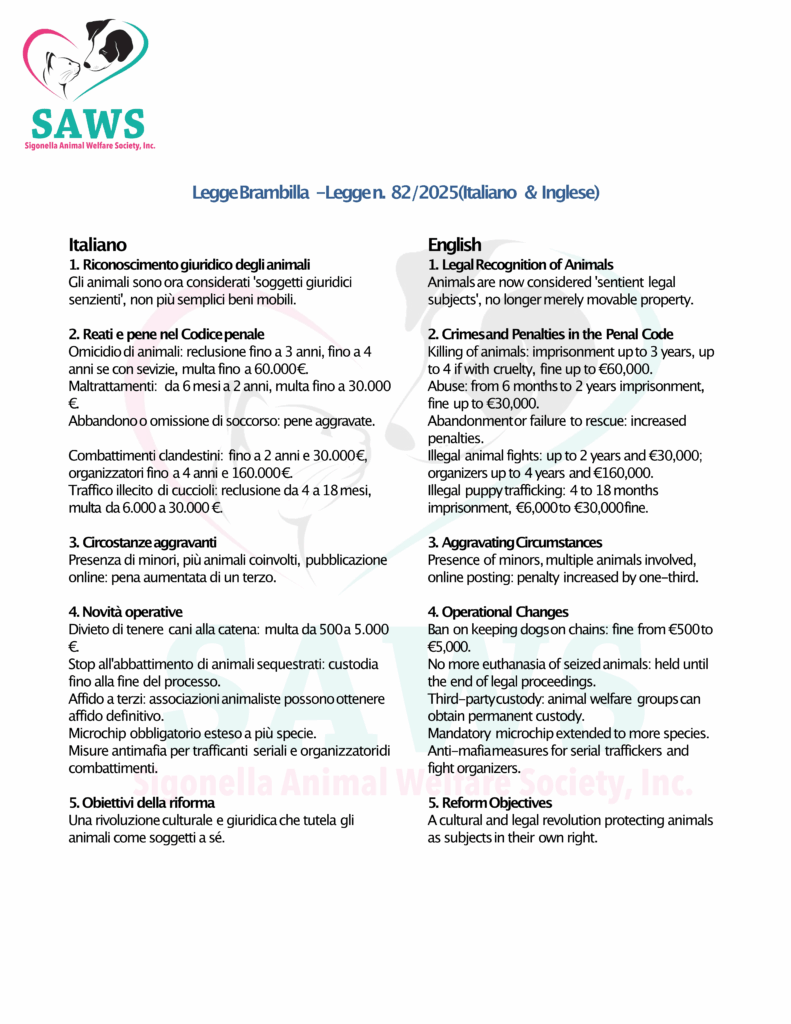
The Brambilla Law

The Brambilla Law

(Law No. 82/2025) came into effect in Italy on July 1. This landmark legislation recognizes animals as sentient legal subjects! An important step for all animals 🫶🏽
 
It started with the brutal killing of Bruno, a 7-year-old police bloodhound in Taranto, Italy. It has literally sparked national outrage.
Known for his heroic work locating nine missing persons, Bruno died after ingesting food laced with nails - an act believed to be a revenge attack tied to his trainer’s animal rescue work. The incident drew strong condemnation from political leaders and animal rights advocates, highlighting the need for stronger animal protection laws.
 
In response to such cruelty, Italy recently enacted the 𝐁𝐫𝐚𝐦𝐛𝐢𝐥𝐥𝐚 𝐋𝐚𝐰 (Law No. 82/2025), which came into effect on July 1 2025. This landmark legislation recognizes animals as 𝐬𝐞𝐧𝐭𝐢𝐞𝐧𝐭 𝐥𝐞𝐠𝐚𝐥 𝐬𝐮𝐛𝐣𝐞𝐜𝐭𝐬 rather than mere property and significantly increases penalties for abuse, killing, abandonment, and illegal trafficking.
Offenders now face up to 4 years in prison and fines up to €60,000, with harsher consequences when crimes involve minors, multiple animals, or are posted online. The law also bans chaining dogs, mandates microchipping for more species, and includes anti-mafia measures for repeat offenders.
  
This reform represents a cultural and legal shift aimed at protecting animals in Italy as beings worthy of dignity and care.
 
Bruno’s death could have been prevented - but his sacrifice will not go in vain. His tragic death has led to the new legislation, and we are looking forward to seeing the results of this new law.
.
The Brambilla law 👇🏼 (click the picture to see the Brambilla Law as a PDF)
. 

Leishmania prevention tips

Leishmania Prevention Tips - here’s a practical guide to preventing Leishmania in dogs, especially if you’re in a hotspot like Sicily:

It is recommended that any healthy dogs living in or visiting areas endemic for Leishmania for purposes such as tourism, or working activities like military, disaster or sentry work, should be protected from sand fly bites to prevent Leishmania infections (individual protection).

Important: Only a sand fly repelling product reduces the risk of infection with Leishmania.

1. Use a good Repellent Collar
Seresto is a top pick—it repels sandflies (plus ticks and fleas).
• Lasts 7–8 months, so it’s great for long seasons.
• Put it on before sandfly season starts (April/May, depending on the weather).

2. Spot-On Treatments
Products like Advantix® Spot-on and Frontline Tri-Act® has pyrethroids (permethrin and deltamethrin) as the active ingredient, which helps repel sandflies.
• Typically applied every 2-4 weeks (be sure to read the recommended application interval for the product).
• Important: almost all pyrethroids are toxic to cats, so be very aware not to use any products that are not licensed for cats.

3. Avoid Sandfly Exposure
Sandflies are most active at dusk and dawn, especially in warm, humid areas.
• Keep dogs indoors at night, especially from May to October.
Use fine mesh screens on windows if you leave them open.
You can also use insecticide-treated nets over dog beds.

4. Vaccination
There’s a vaccine (like CaniLeish) available in Europe.
• It doesn’t prevent infection completely but boosts the immune system so dogs are less likely to get sick.
Usually used alongside other preventive measures—not instead of them.

5. Immune-Boosting Supplements
Some vets recommend Immunoregulin or Leisguard syrup (domperidone) to help the dog’s immune system fight off the parasite.
Ask your vet if it’s suitable for your dog, especially if you’re in an endemic area.

Bonus Tip:
If you’re traveling between high-risk and low-risk areas, always treat dogs before and after the trip — sandflies are sneaky.

What to do if you find an animal in Italy (especially Sicily)

What to do if you find an animal in Italy (especially Sicily)

Step 1: Contact the Authorities
• Report the found animal to the Vigili Urbani (local municipal police).
• You can call them or, ideally, go directly to their office — this usually gets the quickest response.

Step 2: Follow Their Instructions
• The Vigili Urbani will often refer you to the ASP (Azienda Sanitaria Provinciale) – this is the local Animal Protection Agency.
• If the animal is injured, ASP will handle immediate veterinary care.

Step 3: Next Steps After Medical Care
• Once stabilized (if necessary), the animal will need a volunteer or responsible person to continue its care.
• This could include temporary fostering, rehoming, or coordinating adoption efforts.

Step 4: Involve Local Support Groups
Sigonella Animal Welfare Society Inc.  (SAWS Inc.) may be able to step in, if:
They have available funds for medical or basic care.
They have a foster home open and willing to take the animal.

Helpful Tips:
• Take photos and note the location where the animal was found. This helps with any legal or shelter paperwork.

• If the animal is friendly and not in immediate danger, keep it in a safe space (like your car or a crate) while you wait for help or coordinate transport.

• Never assume the animal will be taken by authorities right away—follow up if needed.

• No matter how much SAWS wants to help all the animals found and rescued in Sicily, we only have the hands of ourselves and our volunteers. We do not have a shelter, and unfortunately we might have to say no to taking in more animals, if we are at max capacity.

Need Help Navigating the Italian System?

We’re here for you! Contact us at info@pawsofsaws.org for assistance with registration, vet referrals, and community support.

Italian law (highlights)

Italian law (highlights)
Are you new to Italy with pets? Here’s what you must know!

Moving to or living in Italy with a furry companion? Don’t get caught off guard. Italy takes animal welfare seriously, and the rules apply to everyone, including foreigners and military families.

Here are the basics you need to know (based on national and regional laws like L.R. 15/2022 – Sicily):

1. Pet Registration (Microchip) – Mandatory!
• All dogs (and in some areas, cats and ferrets) must be microchipped and registered in the Italian Pet Registry (Anagrafe Animali d’Affezione) within 30 days of arrival or acquisition.
• If your pet already has a foreign microchip, it still needs to be registered locally (this does not mean a new chip, though).

2. Vaccinations
• Rabies vaccine is required for international travel but not mandatory in every region. However, core vaccinations (distemper, parvo, etc.) are strongly advised and may be required in shelters or boarding facilities.

• For cats: consider vaccines for panleukopenia, calicivirus, and herpesvirus.

3. Sterilization and Stray Prevention
• In many parts of Italy, sterilization is encouraged (and often subsidized) to reduce stray populations.
• It’s illegal to abandon a pet under any circumstances.

4. Pet Welfare
• You’re legally responsible for your pet’s health and well-being. This includes providing proper food, water, shelter, and veterinary care.
• Leaving pets on balconies without protection, or tethered for long hours, may result in fines or confiscation.

5. Identification and Ownership
• If you adopt or foster from a local shelter, the pet must be registered under your name at the base vet or ASP (local health authority).
• Changing ownership? Update the registry!

6. Fines and Inspections
• Violating these laws can result in fines from €75 to €450.
• Regular checks are performed by ASP and local police — especially in animal welfare cases.

Need Help Navigating the Italian System?
We’re here for you! Contact us at info@pawsofsaws.org for assistance with registration, vet referrals, and community support.